Growth and monetization case study
DENUM
A product-led transformation in a competitive fintech market: simplifying onboarding, reprioritizing the product, and reshaping pricing mechanics to grow users, revenue, and profit without leaning on more marketing spend.


Quantitative outcomes
Growth, but with healthier economics
The case framed success as a business outcome across the whole product model: more new users, stronger revenue, and profit growth that outpaced both.
Improvement in new user acquisition after simplifying the journey and clarifying value.
Revenue growth unlocked through pricing refinement and better upgrade visibility.
Profit rose disproportionately through cost-aware product decisions and simplification.
From discovery and market research to milestone delivery and results measurement.
Challenge
What had to change
The original case positioned Denum as a product operating under heavy competitive pressure and weak unit economics, where better product decisions were the main growth lever.
Problem statement

Despite stable traffic and brand awareness, the product showed low conversion from visitor to registered user, high onboarding drop-off, weak alignment between features and user needs, and monetization mechanics that underperformed in a price-sensitive market.
- Stagnating new user acquisition.
- Inefficient conversion funnel and overloaded onboarding.
- Rising operational costs harming profitability.
- Limited product differentiation in a crowded fintech space.
Solution

I led a product-led transformation focused on simplifying the user journey, realigning core features with high-value user needs, optimizing pricing logic, and reducing operational complexity so growth could become more scalable and profitable.
- Increase new user acquisition.
- Improve revenue performance.
- Achieve significant profit growth.
- Do it through product improvements rather than increased marketing spend.
Role
The growth model behind the work
Discovery & Research
Interview active and churned users, inspect behavior across the funnel, and benchmark the market.
Product Strategy & Prioritization
Define a growth-focused strategy and make trade-offs around low-value, high-cost features.
UX & Funnel Optimization
Redesign onboarding and activation flows so users reach value faster and drop less often.
Monetization & Cost Efficiency
Improve pricing clarity, optimize upgrade moments, and simplify the product model for better margins.
Process
From discovery to durable economics
I kept the original delivery logic intact, but restructured it into one readable system: a high-level transformation arc and four concrete milestone blocks.
Transformation arc
The work started with research, moved through strategy, and landed in execution across funnel, pricing, and cost structure.
Discover
Strategize
Execute
Scale
01
User and market research
Find where value clarity, onboarding, and feature prioritization were breaking down.
02
Strategy and hypotheses
Turn discovery into concrete bets around activation, monetization, and cost-aware product design.
03
Execution and milestones
Ship improvements across onboarding, roadmap focus, pricing, and operational simplification.
04
Results and learnings
Measure outcomes and capture what actually drove the business improvement.
Milestone 1
Funnel & onboarding redesign
Reduce the time and effort needed to reach the core action, and make the value proposition understandable in the first minutes.
- Rebuild onboarding around time-to-value.
- Reduce the number of required steps to reach the core action.
- Introduce contextual guidance instead of static explanations.
- Deliver measurable improvement in registration and activation rates.
Milestone 2
Core feature prioritization
Move the product closer to real user jobs by cutting expensive noise and reinforcing the capabilities tied to retention and monetization.
- Audit existing features by usage, cost, and business impact.
- Deprecate or deprioritize low-value, high-cost functionality.
- Enhance features directly linked to user retention and monetization.
- Increase engagement with fewer but more valuable features.
Milestone 3
Monetization & pricing optimization
Use pricing and upgrade mechanics as a product experience, not just a billing layer, to increase revenue efficiency.
- Revise pricing structure by segment and usage patterns.
- Improve visibility and clarity of paid plans.
- Optimize upgrade moments across the journey.
- Generate a significant uplift in revenue per user.
Milestone 4
Cost & efficiency optimization
Make the product easier to maintain and easier to grow by simplifying the system behind the experience.
- Simplify product logic and internal processes.
- Reduce maintenance and operational overhead.
- Improve alignment across product, engineering, and marketing.
- Create profit growth that outpaces revenue growth.
Research
What the evidence revealed
The original Denum case combined qualitative interviews, funnel analytics, and competitive review to diagnose both growth blockers and monetization friction.
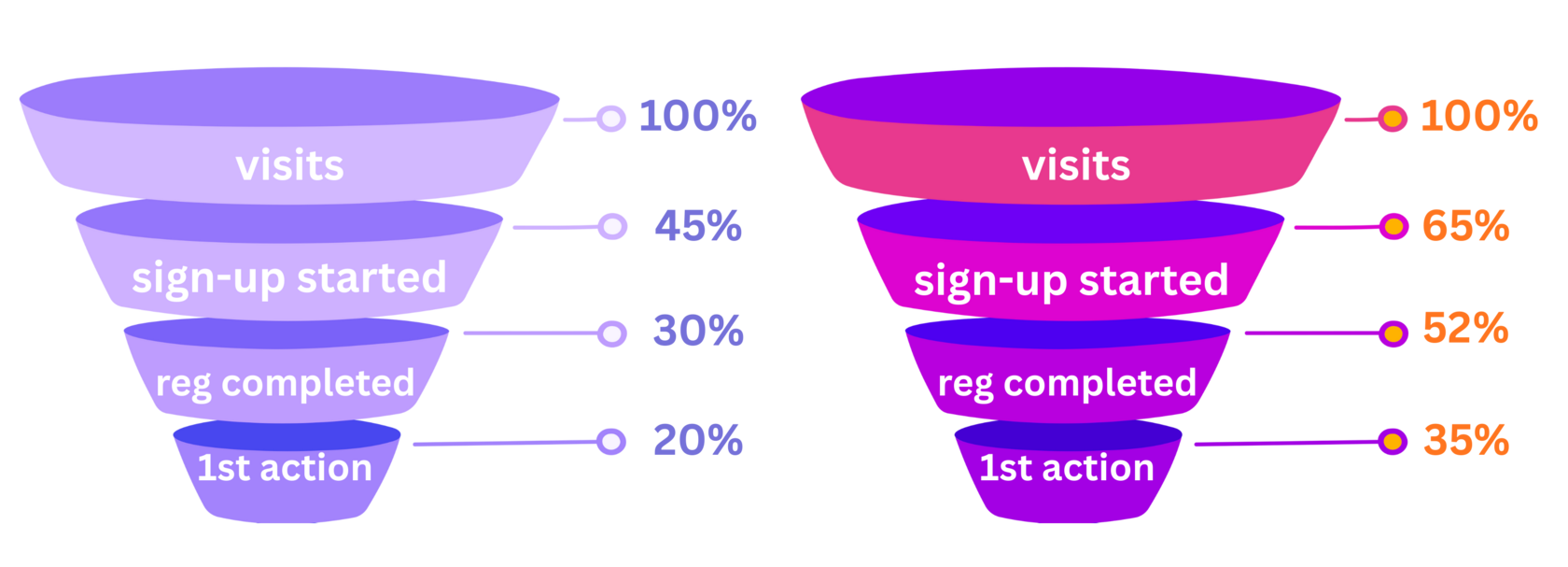
Funnel redesign lens
The work focused on improving progression from visit to sign-up, registration completion, and first meaningful action.
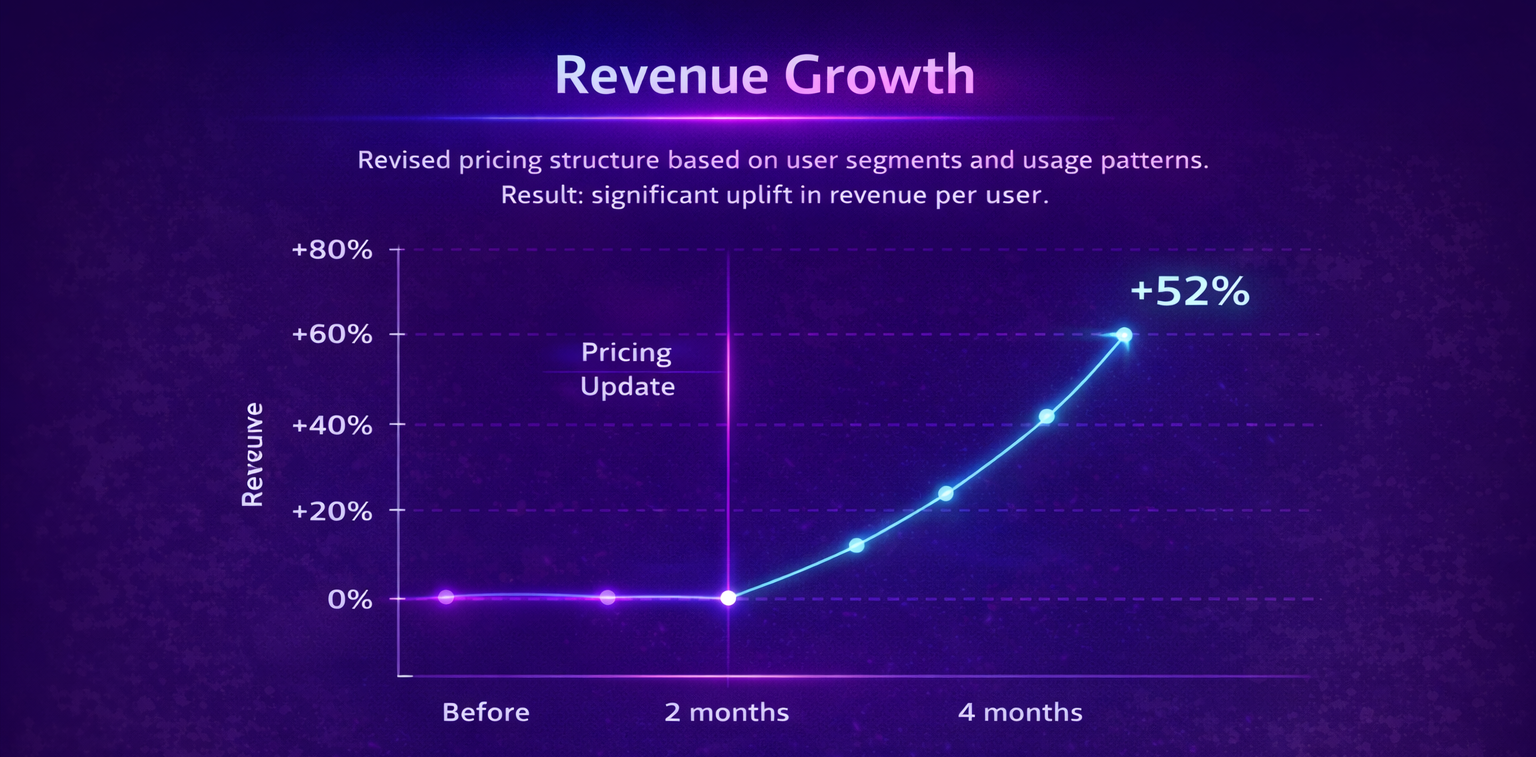
Revenue effect
Pricing and monetization changes were treated as product design decisions with measurable business impact.
The discovery work surfaced a consistent pattern: people were not reaching the “aha” moment fast enough, and the product economics were not aligned with what users actually valued.
User interviews and behavioral analysis
Interviews with active and churned users, plus funnel analysis across activation, engagement, and drop-off points, showed where the experience was losing momentum.
Key friction points
Users struggled to understand the core value proposition quickly, onboarding was overloaded and poorly sequenced, and pricing did not feel clearly matched to value.
Competitive review
Market leaders were benchmarked on positioning, pricing, onboarding quality, and perceived fairness to identify where Denum could compete more effectively.
MoneyMan
Zaymer
Webbankir
Turbozaim
eKapusta
Strategic hypotheses
Simplify onboarding, clarify value earlier, prioritize core user jobs, improve pricing logic, and reduce operational complexity to unlock more scalable growth.
Decisions
The product changes that mattered most
To keep the case readable, I regrouped the original interventions into four practical decision areas instead of a long exported list.
Clarify value before asking for effort
Re-sequence the early experience so users understand the product promise before they face friction-heavy registration steps.
Strip onboarding down to its highest-yield path
Shorten the journey to the first meaningful action and replace bulky explanation blocks with contextual help at the moment of need.
Reward core jobs, not feature sprawl
Audit the roadmap through usage, cost, and retention impact, then deprioritize features that create drag without creating value.
Treat monetization as product design
Refine pricing, plan clarity, and upgrade timing so revenue growth comes from a better experience, not from more top-of-funnel spend.
Product screens
How the funnel became easier to complete
The original case included representative mobile flows that show the onboarding and verification experience becoming more guided and easier to progress through.

Entry and offer comprehension
The flow starts by making the value proposition and first action visible immediately, instead of hiding them behind too much setup.

Guided application step
Structured fields and visible progress reduce uncertainty and make each step feel more manageable.

Lower-friction verification
Automation and document support reduce manual effort and help users move through identity steps with less fatigue.
Results
What the transformation delivered
The outcome was not just a better funnel. It was a more scalable operating model where product growth and business efficiency started reinforcing each other.
Quantitative outcomes
The case explicitly framed success with three headline metrics, backed by better revenue efficiency and stronger funnel progression.
+40%
Increase in new user acquisition.
+52%
Revenue growth after pricing and monetization optimization.
+174%
Profit growth driven by cost-aware product simplification.
Qualitative impact and learnings
The work also produced a clearer product model, stronger internal alignment, and a more defensible growth strategy.
- Clearer product positioning and better alignment with user needs.
- More scalable and maintainable product architecture.
- Simplification proved to be the strongest growth lever.
- Profit can outpace revenue when product decisions are cost-aware.
- Clarity of value matters more than feature volume in competitive fintech.